
Free briquetting press calculator
How many briquetting presses does your waste need?
Tell us what you fill and how often. You get the BrikStar model, how many presses to link, how long it runs each day and what your waste turns into. It works with any brand of dust collector.
Updated November 2026 by Höcker North America.
Quick answer
What size briquetting press do I need? Divide the pounds of waste you make each day by the hours the press can run. Then pick the smallest press that handles that rate at about 85% of its rated output for your material. BrikStar presses run from about 110 lb/h (BrikStar 3) to 375 lb/h (BrikStar 11), and up to four can be linked on one feed container.
How the briquetting press calculator works
From drums and dumpsters to the right press, in three steps
Containers to pounds
Most shops don't weigh waste, but they know what they fill. The calculator multiplies the volume you fill by the loose density of your material. A 55-gallon drum of mixed chips weighs about 75 lb.
Pounds per press hour
It adds your growth allowance, then divides by the hours the press can run. A press that runs longer can be smaller, if the waste has somewhere to wait.
Smallest press at 85%
It picks the smallest BrikStar that handles that rate at no more than 85% of its output for your material. Above one BrikStar 11, it splits the load across linked presses.
Assumed density and pressing rate by material
| Material | Loose lb/cu ft | Pressing rate |
|---|---|---|
| Softwood shavings | 8 | 100% |
| Mixed hardwood and softwood | 10 | 100% |
| Hardwood chips and sawdust | 12 | 100% |
| Fine sanding dust | 15 | 90% |
| MDF or particleboard | 18 | 80% |
| Paper, plastic, or other | 8 | 80% |
Typical planning figures for loose, dry material. Harder material like MDF presses slower. Fine sanding dust makes crumbly briquettes on its own, so mix it with chips. A test pressing of your own material settles the number.
Why the calculator sizes to 85% of rated output
A press that runs flat out every hour has nothing left for a busy day. The calculator keeps about 15% headroom for:
- Material that changes from job to job
- Damp or fine material that presses slower
- Extra production on a heavy week
Then add 25% or 50% for growth. If you already know a shift or a machine is coming, pick the larger allowance.
The BrikStar range
BrikStar models and rated output
Every BrikStar C and BrikStar V comes in the same five sizes. The number tracks the hydraulic motor: a bigger motor presses more material per hour.
| Model | Max output | Hydraulic motor |
|---|---|---|
| BrikStar C3 / V3 | 110 lb/h | 4 HP |
| BrikStar C4 / V4 | 154 lb/h | 5.4 HP |
| BrikStar C5 / V5 | 220 lb/h | 7.4 HP |
| BrikStar C7 / V7 | 287 lb/h | 10 HP |
| BrikStar C11 / V11 | 375 lb/h | 14.8 HP |
Max output depends on material. All models press a 2.6 inch briquette, with a 2.2 inch option for hard-to-press material like MDF. Full specifications are in the BrikStar C and V brochure (PDF).
C and VBriquetting presses for wood waste
Free brochure
Get the BrikStar brochure
Every BrikStar model in one PDF. Enter your email and we send it straight to your inbox.
- Specifications for all five sizes, from the 3 to the 11
- BrikStar C (compact) and BrikStar V (variable) layouts side by side
- Options like oil cooling, bagging and the smaller briquette for MDF
One email with the PDF, no newsletter. Privacy policy
We sent the brochure to . Want it now?
Open the brochureLayout, not output
BrikStar C or BrikStar V: which one the calculator picks
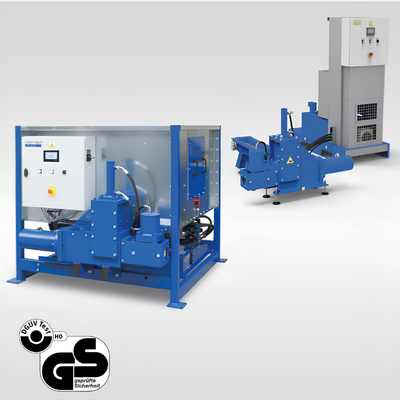
Both series press the same briquette at the same rates. The difference is how the press fits your floor.
The press, feed screw, hydraulics, controls and feed container come as one unit, delivered ready to plug in.
Picked when you have floor space beside the collector.The press, feed screw, hydraulic unit and control cabinet are separate units. The collector can sit outside, the feed screw can run through the wall and the press can work in the next room.
Picked when space is tight or you need more than one press.How the calculator links multiple presses
When your volume is more than one BrikStar 11 can handle, the calculator works out how many presses you need, then picks the smallest model that carries an equal share.
Up to four BrikStar V presses run from one feed container, for up to about 1,540 lb/h. Beyond that, Höcker project specialists engineer a multi-line system around your plant.
How long the press runs each day
The calculator sizes the press to run during your production hours, so it keeps up with the waste as you make it.
If your waste can wait in a silo with a transport line, the press can run longer, 16 hours or around the clock, and a smaller press may do the job. A specialist checks that with you. A press that runs 16 hours or more needs oil cooling, standard on the 7 and 11.
What your waste turns into
Pay to haul it away, or press it into fuel
The calculator shows that heat value in MMBtu and in gallons of propane, so you can compare it to what you burn now. Add your monthly hauling cost in the form and we'll weigh it against the press.
Worked example: a cabinet shop
About three cubic yards (800 lb) of mixed hardwood and softwood a day, one 8-hour shift, five days a week, 25% room to grow.
| Waste per day | 800 lb | 80 cu ft at about 10 lb per cu ft |
| Required rate | 125 lb/h | 800 lb plus 25% growth, over 8 press hours |
| Recommended | BrikStar C4 | Smallest model that handles 125 lb/h at 85% of rated output |
| Capacity used | 81% | 125 lb/h against 154 lb/h rated |
| Press run time | 5.2 h/day | Automatic start and stop handles the rest |
| Waste per year | 104 tons | 800 lb a day, 260 days a year |
| Volume per year | 770 cu yd | Becomes about 77 cu yd as briquettes |
| Heat value per year | 1,768 MMBtu | About 19,300 gallons of propane |
Same shop at four times the volume with no room beside the collector: 500 lb/h, two linked BrikStar V11 presses on one container, running at about two-thirds of capacity.
The fine print
What the briquetting press calculator does not cover
Output is only part of a working briquetting system. Final design also depends on:
- Material moisture and particle size
- How the press mounts under or connects to your collector or separator
- Where the press can safely sit
- Indoor or outdoor placement, and climate if the press sits outdoors
- How briquettes leave the press: bins, bags or a conveyor
- What happens if the press stops
If the press stops, does your shop stop?
If the press goes down and the collector has nowhere to dump, production stops too. That's why we design the press and the dust collection system to work together, with buffer storage where it's needed.
A BrikStar connects to collectors and separators from any manufacturer. Still sizing the collector itself? Start with the CFM calculator.
Questions
Briquetting press calculator FAQs
What size briquetting press do I need?
+
Divide the pounds of waste you make each day by the hours the press can run. Then choose the smallest press that handles that rate at about 85% of its rated output for your material. BrikStar presses range from about 110 lb/h for the BrikStar 3 to about 375 lb/h for the BrikStar 11.
How much does wood waste weigh?
+
Loose wood waste usually weighs between 8 and 18 pounds per cubic foot. Light softwood shavings sit at the low end, while fine sanding dust and MDF dust sit at the high end. A full 55-gallon drum of mixed chips weighs roughly 75 pounds.
How many briquetting presses can be linked together?
+
Up to four BrikStar V presses can run from one feed container, for up to about 1,540 lb/h. Above that, Höcker project specialists engineer a multi-line system for the plant.
What is the difference between the BrikStar C and BrikStar V?
+
The BrikStar C is a compact, all-in-one press with its own feed container, delivered ready to plug in. The BrikStar V splits the press, feed screw, hydraulic unit and controls into separate units, so it fits tight spaces, adjoining rooms and multi-press systems.
Can a briquetting press connect to my existing dust collector?
+
Yes. A BrikStar press connects to collectors and separators from any manufacturer, so you don't need a Höcker dust collection system to add one. A specialist confirms the connection, feed and layout as part of the free review.
How much does briquetting reduce waste volume?
+
Briquetting reduces the volume of loose material by up to 10 to 1, or up to 90%. That means fewer containers, fewer dumpster pulls and less floor space spent on storage.
Can I burn wood briquettes for heat?
+
Yes. Wood briquettes carry up to about 8,500 Btu per pound, so many shops burn them for heat or sell them. Burn only clean wood briquettes in equipment rated for wood fuel, and check local air permit rules first.
Does briquetting help with combustible dust?
+
It helps. Pressing loose dust into dense briquettes means far less loose, fine material sitting in bins and storage areas. The collection system itself still falls under the combustible dust requirements in NFPA 660, Chapter 24 for woodworking, and should be covered by your Dust Hazard Analysis.
Is this briquetting press calculator a substitute for an engineered design?
+
No. The calculator gives you a solid starting estimate of press model, quantity and run time. A specialist confirms every number against your material, layout and collector before a quote is issued. The calculator is free with no sign-up, and the specialist review is free too.
Sources: Höcker Polytechnik, BrikStar C and V brochure; NFPA 660, Standard for Combustible Dusts and Particulate Solids.
Calculator results are planning estimates based on typical loose densities and rated press output. Pressing rate depends on material, moisture and particle size. A Höcker specialist confirms sizing before any quote.