
Free dust collection energy calculator
How much is your dust collector fan wasting?
Most fans run flat out all shift, even when half the machines are off. Höcker's multiple fan solution, with variable frequency drives and automatic blast gates, cuts fan power by up to 60%. See what that's worth in your shop.
Updated November 2026 by Höcker North America.
Fan energy savings calculator
No automatic blast gates? Then your fan runs as if all 10 are on, every hour of the shift. Pick how many actually run, and we show what gates and a drive would save.
Get the full report free: payback, rebate check and an engineer review.
Estimate with Höcker's multiple fan solution, variable frequency drives and automatic blast gates. See the math.
Quick answer
How much energy does a dust collector waste? A single fan running at full speed while only 7 of 10 machines are working uses about twice the power it needs. Höcker's multiple fan solution, with variable frequency drives and automatic blast gates, slows each fan to match the machines that are running, which cuts fan power by up to 60%. For a 50 HP fan on two shifts at the U.S. average business rate of 14.5 cents per kWh, that is about $9,100 a year.
What you get, free
Your energy report does more than this calculator
Savings for every fan
Your numbers in dollars, kWh and CO₂, line by line.
Payback estimate
An engineer checks your fan curve and tells you how fast it pays for itself.
Utility rebate check
We look up incentives your utility pays for drives and motors.
NFPA 660 review
Return-air and blast gate layout checked against the combustible dust standard.
How the savings work
You only pay for the air your machines use
Fan power with 7 of 10 machines running
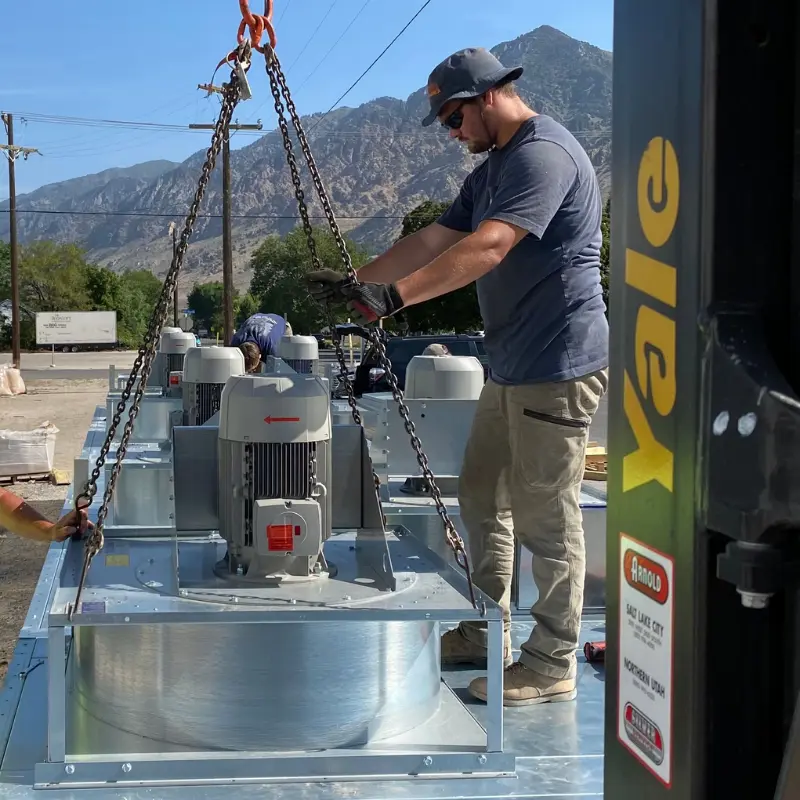
Instead of one oversized fan and trunk line, Höcker splits the system into multiple fans, each on a variable frequency drive. Automatic blast gates close when a machine stops, and each fan slows to match. Smaller lines also need less power to keep the duct clean.
Savings by machines running
50 HP fan, two shifts, 250 days, 14.5 cents per kWh (U.S. average business rate)
| Machines running | Fan power saved | Per year |
|---|---|---|
| 6 or fewer of 10 | 56% | $10,379 |
| 7 of 10 | 49% | $9,100 |
| 8 of 10 | 34% | $6,256 |
| 9 of 10 | 16% | $3,033 |
| All 10, all shift | 0% | $0 |
Show the math and assumptions+
Fan power today = HP × 0.746 kW × 85% load. With Höcker control = today × (share of machines running)² ÷ 97% drive efficiency. Savings = the difference × hours × days × your rate.
Power rate from your ZIP = your state's average commercial electricity price, U.S. Energy Information Administration, August 2026. Your own bill may be higher or lower, especially on time-of-use or demand pricing.
Demand charges, your fan curve and duct static pressure are not included. An engineer adds those in your report.
Case study
Crystal Cabinet Works cut about 100,000 kWh a year
Princeton, Minnesota. Two Höcker MultiStar collectors, a blast gate on every machine, and Höcker energy management.
Read the case studyQuestions
Dust collection energy FAQ
How much electricity does a dust collector use?
+
A fan draws about 0.63 kW per horsepower at full load. A 50 HP fan on two shifts, 250 days a year, uses about 127,000 kWh, or roughly $18,400 a year at the U.S. average business rate of 14.5 cents per kWh.
How much does Höcker's multiple fan solution save?
+
Up to 60% of fan power. Multiple fans on variable frequency drives, with automatic blast gates, slow down to match the machines that are running. Your savings depend on how many machines run at once.
What if I don't have automatic blast gates?
+
Then your fan runs as if every machine is on, all shift. That is the waste this calculator measures. Pick how many machines actually run on a typical day to see what gates and drives would save.
Where does the power rate come from?
+
Enter your ZIP and we fill in your state's average commercial electricity price from the U.S. Energy Information Administration. For your exact rate, divide your total power bill by the kWh used, delivery included.
Why does Höcker use more than one trunk line?
+
One very large pipe needs a lot of air to keep dust from settling in the duct. Höcker typically stops at a 24 inch trunk line and adds another, which saves energy, reduces the chance of fallout and is easier to install.
Can I add energy management to my existing dust collector?
+
Höcker does not add its fan to another company's system. An engineer reviews your setup and recommends the right path, which may be a full system redesign.
Are there utility rebates for dust collector drives?
+
Often, yes. Crystal Cabinet Works received a $71,000 rebate from Connexus Energy. We check your utility in your free report.
Sources: U.S. Energy Information Administration, Electric Power Monthly Table 5.6.A (August 2026); Connexus Energy (Crystal Cabinet Works).