
Free dust collection sizing tool
Dust collector CFM calculator
How much airflow does your shop need? Pick your machines and the ones you plan to add, and get total CFM, main duct size, the Höcker fans and filter area in seconds. Then see what one fan at full blast costs next to Höcker fans with VFDs.
Updated November 2026 by Höcker North America.
Add a machine to start.
Yearly fan power at the U.S. average business rate, 14.5¢ per kWh. Enter your ZIP for your state’s rate. Assumes 7 of 10 machines running on a typical day, 2 shifts and 250 days. Run your own numbers.
Email me the full sizing sheet: every machine, duct sizes and a free review of duct runs, static pressure and NFPA 660.
Quick answer
How many CFM do I need for a dust collector? Add up the CFM of every machine on the system, with every gate open. That is your demand today. Then add every machine you plan to buy in the next 5 years and size the collector for the total. A cabinet shop with a nested CNC router, a wide belt sander, a planer, sliding table saw, edgebander and jointer needs about 7,550 CFM and an 18 inch main duct. Höcker would run it on 3 fans with variable frequency drives in one outdoor collector, with room for a fourth.
What you get, free
Your sizing sheet is ready to quote from
Every machine, sized
Each machine, its port and its airflow, split into all-shift and on-demand.
Main duct or trunk lines
Sized for 4,500 feet per minute. We keep trunk lines around 24 inches and add lines instead of going bigger.
Höcker fans and fan cost
How many Höcker fans, what size and which collector, plus what one fan at full blast costs a year next to them.
NFPA 660 review
Collector location, explosion protection and ductwork checked against the standard.
How the dust collector CFM calculator works
Size by machines, not square footage
Pick your machines
Each one starts at its typical CFM. The name shows the blade, wheel or width. The port size is listed separately. Know your manufacturer's number? Type it in.
Add what's coming
Planning to add machines in the next 5 years? Pick them. You see your demand today and in 5 years, and the duct, fans and filter area are sized for the total.
Compare the fans
See what one fan at full blast costs a year next to Höcker's multiple fans with VFDs, which slow down and switch off as automatic gates close.
Why size for what runs at once
A cabinet shop with a nested CNC router and a wide belt sander running all shift, plus two people moving between a planer, sliding table saw, edgebander and jointer:
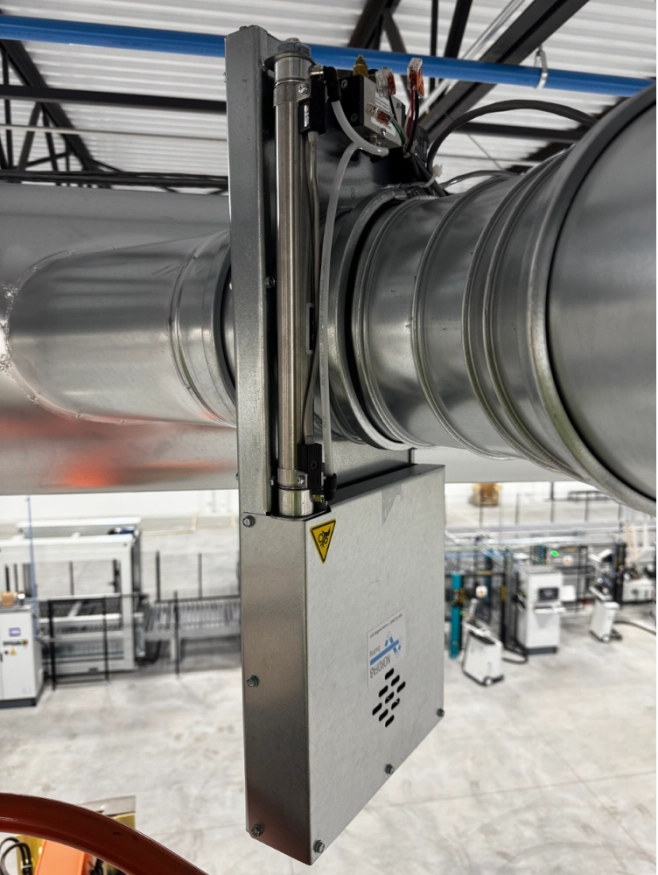
A smaller fan running every hour of every shift. Automatic blast gates on every branch send the air only to the machines in use.
Show the math and assumptions+
Current demand = the CFM of every machine on the system, with every gate open. Future demand = current demand + every machine you plan to add in the next 5 years, rounded to 25. Everything below is sized for future demand.
Main duct = the next standard size that keeps air at 4,500 feet per minute. We try to keep trunk lines around 24 inches, because a bigger pipe needs higher static pressure, and add lines instead. Very large systems bring about 3 larger lines into the filter and split them inside the plant. Trunk sizes are an estimate. Fan power needed = future demand × 12 in static pressure ÷ (6,356 × 65% fan efficiency). Höcker fans: three standard sizes, 25 kW (34 HP), 33 kW (45 HP) and 44 kW (60 HP). We start with 3 fans and size each one close to its share, using the fewest collectors. Each 6×6×16 outdoor collector holds 4 fans, so a 3-fan system has 25% room to grow; more fans add a second collector (6×12×16). At or under 5,000 CFM, a Vacumobil usually fits instead. Filter area = future demand ÷ 2 (air-to-cloth ratio).
By port = port area × 4,500 feet per minute branch velocity, when you size a machine by its port instead of its typical average.
Fan cost = one fan big enough for the whole system × 0.746 × 85% load. One fan at full blast draws that all shift. Höcker fans with VFDs draw about (share of machines running)² of it ÷ 97% drive efficiency, so with 7 of 10 machines running they use about half. Yearly cost assumes 2 shifts, 250 days and 14.5¢ per kWh.
Duct runs, static pressure and NFPA 660 requirements are checked when you request your sizing sheet.
Typical CFM by machine
The starting airflow the calculator uses. The size in the name is the blade, wheel or working width, not the dust port.
| Machine | Typical CFM |
|---|---|
| Moulder, four side | 3,000 |
| CNC router, 5 x 10 nested base | 2,500 |
| Wide belt sander, 37 to 43 in wide | 2,300 |
| Panel saw / beam saw | 1,500 to 3,000 |
| CNC router, 4 x 8 single head | 1,500 |
| Edgebander, compact | 850 |
| Planer, 16 to 20 in wide | 775 |
| Sliding table saw | 700 |
| Shaper | 550 |
| Table saw, 10 in blade | 500 |
| Jointer, 6 to 8 in wide | 425 |
CFM by port size
At 4,500 feet per minute, for when you size a machine by its dust port.
| Port | CFM |
|---|---|
| 4 in port | 395 |
| 5 in port | 615 |
| 6 in port | 885 |
| 8 in port | 1,570 |
| 10 in port | 2,455 |
| 12 in port | 3,535 |
When one main duct isn't enough
Höcker stops at a 24 inch trunk line. A bigger pipe needs a lot more air to keep dust from settling, so above about 12,500 CFM we split the system into two or more trunk lines. It saves fan energy, lowers the chance of fallout in the duct and is easier to install.
Questions
Dust collector CFM calculator FAQ
How many CFM do I need for a dust collector?
+
Add up the CFM of every machine on the system, with every gate open. That is your demand today. Add the machines you plan to buy in the next 5 years and size for the total. The dust collector CFM calculator does it for you.
Why not size by shop square footage?
+
Floor space doesn't make dust. Machines do. Two shops the same size can need very different systems.
What size main duct do I need?
+
Size the main so air moves at about 4,500 feet per minute. Too big and dust settles in the duct. Too small and you need a bigger motor. Höcker keeps trunk lines around 24 inches and adds another line instead of going bigger.
Why does Höcker use more than one trunk line?
+
One very large pipe needs a lot of air and higher static pressure to keep dust from settling in the duct. Several lines around 24 inches give better energy management, less chance of fallout, and they are much easier to install.
Why does Höcker use more than one fan?
+
One big fan runs at full speed all shift, even when most gates are closed. Höcker splits the airflow across 3 or more fans, each sized close to its share, with variable frequency drives. As automatic blast gates close, the fans slow down and switch off, so you pay for the air you use. With 7 of 10 machines running, that is about half the fan power.
How do I size for machines I will add later?
+
List them instead of adding a flat percentage. Add every machine you expect to buy in the next 5 years, and size the collector for today's demand plus those machines. The calculator shows both numbers side by side.
How many CFM does a panel saw need?
+
A panel saw or beam saw typically needs 1,500 to 3,000 CFM, depending on its size and how many hoods and ports it has. The calculator starts at 1,750 CFM. Enter your manufacturer's number if you have it.
Is the machine size the same as the dust port size?
+
No. A 10 inch table saw has a 10 inch blade, but its dust port is usually 4 or 5 inches. The calculator names each machine by its blade, wheel or working width and lists the port separately. Sizing by port uses 4,500 feet per minute in the branch.
Does NFPA 660 apply to my woodworking shop?
+
Yes. NFPA 660 now covers wood dust and replaced NFPA 664. It sets rules for collector location, explosion protection and ductwork. This calculator sizes airflow only.
Can someone check my numbers?
+
Yes, free. Request your sizing sheet and we review it against your duct layout, static pressure and NFPA 660 within one business day. Or call Bennett Dipzinski at 616.881.6698.
Sources: Höcker North America machine airflow data; NFPA 660, Standard for Combustible Dusts and Particulate Solids.