
Achieve NFPA Compliance with Confidence

Technical Insights on DHA, Regulations, and Spark Detection for Woodworking Engineers

Self-checkNFPA 660

Is your shop ready for NFPA 660?

Ten yes-or-no questions. Get a readiness score and a plain-language gap list in about three minutes.

  • Dust Hazard Analysis
  • Collector location
  • Explosion protection and isolation
  • Spark detection
  • Ductwork and housekeeping
  • Training and inspections

Free. Your answers stay on the page unless you ask for the report.

Take the readiness check

In the woodworking industry, the risks associated with combustible dust are real and significant.

The National Fire Protection Association (NFPA) provides comprehensive standards to minimize fire and explosion hazards in woodworking operations. For engineers and technicians, mastering these standards — especially NFPA 652 and NFPA 664 — is imperative for maintaining safety, compliance, and operational efficiency.

This guide covers everything from conducting a Dust Hazard Analysis (DHA) to key regulations for interior and exterior dust collection systems and the essential role of spark detection. 

Let's explore how dust explosions occur and the engineering controls necessary to mitigate your risk.

Dust Hazard Analysis (DHA): The Foundation of Safety

A Dust Hazard Analysis (DHA) is a detailed evaluation of your facility’s combustible dust risks. According to NFPA 652, any facility handling or generating combustible dust must conduct a DHA to assess the potential for fire, explosion, and dust-related hazards. For engineers, this process is both highly technical and crucial for compliance.


How to Conduct a DHA

1. Identify Combustible Dust Sources: Any point in the process where wood dust is generated, handled, or stored should be assessed. Common sources include sanding machines, cutting equipment, dust collection systems, and storage areas.


2. Evaluate Dust Accumulation and Dispersion: Dust can settle on surfaces or be suspended in the air, creating a potential explosion hazard. Engineers must evaluate where dust is accumulating and how it is being dispersed within the facility.


3.  Analyze Potential Ignition Sources: Electrical components, machinery friction, hot surfaces, and static electricity are all potential ignition sources. A thorough DHA will document all possible ignition points within the system.
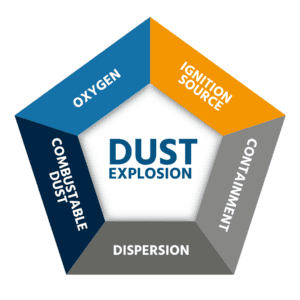
dust explosion chart from hocker north america


4.  Understanding Dust Explosions: The Explosion Pentagon

  • Oxidant (oxygen in the air)
  • Ignition Source (heat, sparks, static electricity)
  • Fuel (combustible dust)
  • Dust Dispersion (dust suspended in the air)
  • Confinement (pressure buildup in an enclosed space) 

When all five factors are present, a dust explosion can occur, starting with a primary explosion that can lead to more destructive secondary explosions. Even a minimal accumulation of dust (1/32 inch) can cause secondary explosions, especially if the dust has settled on surfaces like rafters or equipment.


5.  Review Current Mitigation Controls: Evaluate current fire prevention measures, including dust collection efficiency, spark detection, and explosion suppression systems. Are these systems functioning as intended? Do they meet the scale of your facility’s dust production?


6.  Risk Assessment and Recommendations: Once the hazards are identified, assess the level of risk and prioritize which areas require immediate attention. Recommendations should be based on a technical analysis of the dust collection efficiency, spark detection systems, and airflow management.


When to Conduct a DHA:

  • Initial Setup: A DHA is required when setting up a new woodworking operation.
  • System Modifications: If equipment, ductwork, or dust collection systems change, update the DHA accordingly.
  • Periodic Reviews: NFPA 652 mandates that DHAs be reviewed and updated every 5 years, ensuring ongoing safety and compliance as your facility evolves.

Read more on how to conduct a full DHA to ensure your facility is in compliance.



ben the dust guy of hocker north americaPro Tip: When conducting a DHA, consider using high-precision tools like real-time particle counters and Computational Fluid Dynamics (CFD) simulations to map dust dispersion patterns. These advanced techniques provide deeper insights into your facility’s dust behavior, allowing for more targeted mitigation strategies and long-term safety improvements.

Interior & Exterior Dust Collection: What Are the NFPA Rules?

Updated October 2026: NFPA 664, the old woodworking dust standard, has been folded into NFPA 660. Wood processing and woodworking rules now live in Chapter 24. This guide reflects that change.

Quick answer

Can a dust collector go inside the building? Yes, but only with the right protection. Under NFPA 660, an indoor collector needs a way to handle an explosion without sending flame into the shop (flameless venting or suppression), isolation so a blast can't travel through the ductwork, and a Dust Hazard Analysis that backs up the design. Outdoor collectors still need protection too, but they can vent an explosion straight to a safe outdoor area.

Not sure which one fits your shop? Take the 60-second indoor or outdoor check.

Key Rules for Interior Systems

For interior dust collection systems, NFPA 660 (Chapter 24 for wood) sets the rules for controlling combustible dust. The goal is simple: collect the dust, keep it contained, and make sure a fire or explosion inside the collector stays there.

  1. Air Filtration and Recirculation: Systems that return filtered air to the shop need high-efficiency filtration plus isolation on the clean-air side, so flame or burning material can't ride the return air back into your workspace. Done right, returning air keeps your heated or cooled air inside, which can cut energy costs in a big way. See what that's worth with our dust collection energy calculator.
  2. Dust Accumulation Limits: NFPA limits how much dust can build up on floors, beams, ledges, and equipment before it counts as an explosion hazard. The long-standing benchmark is 1/32 inch over 5% of the floor area, about the thickness of a paperclip. If you can write your name in the dust, you've got a problem.
  3. Fire and Explosion Protection: Indoor collectors need explosion protection that keeps flame out of the room, such as flameless venting or chemical suppression. Spark detection and extinguishing in the ductwork stops an ember before it ever reaches the collector. Read more on when you need spark detection.
  4. Maintenance and Housekeeping: Regular maintenance, including filter replacement and duct cleaning, keeps your system compliant. Inspect often, document what you checked and when, and keep that record handy for your insurer or fire marshal.

Key Rules for Exterior Systems

For woodworking facilities with exterior dust collection systems, NFPA 660 and NFPA 68 set clear rules to prevent explosions and keep dust handling safe.

  1. Placement and Distances: Outdoor collectors must sit where an explosion can be safely released, away from doors, walkways, windows, and places people gather. There isn't one magic number that fits every shop. Your Dust Hazard Analysis, vent sizing, and local fire marshal (the AHJ) decide the safe zone.
  2. Explosion Venting: Explosion vents must direct blast pressure and flame away from structures and personnel. The vents have to be sized for your collector and your dust, and the discharge area needs to stay clear.
  3. Weatherproofing and Durability: Outdoor systems must stand up to rain, wind, heat, and cold. Ductwork and equipment should be corrosion-resistant and sealed for the long haul.
  4. Grounding and Bonding: Static electricity builds up fast in dust collection systems. All equipment, ductwork, and machinery must be properly grounded and bonded so static charges dissipate safely instead of becoming an ignition source.
Pro Tip from Ben the Dust Guy: Install pressure sensors and static monitors on both interior and exterior systems to track real-time performance. They help you catch dust buildup and pressure problems early, so you stay compliant and your shop keeps running.

Interior vs. Exterior Dust Collection at a Glance

 Interior (indoor) collectorExterior (outdoor) collector
Where it can goInside, when the design is backed by a Dust Hazard Analysis. Enclosureless units are limited to 5,000 CFM and must sit at least 20 ft from exits and occupied areas.Outside the building, positioned so vent discharge can't reach people, doors, or walkways.
Explosion protectionFlameless venting or chemical suppression, since flame can't be vented into the shop.Explosion vents that discharge to a safe outdoor area.
IsolationOn the dust discharge, plus the clean-air side if air returns to the shop.Usually needed to keep a blast from traveling back through the ductwork into the building.
Energy impactFiltered air can return to the shop, keeping heating and cooling dollars inside.Air is often exhausted outside, so you pay to heat or cool its replacement.
WeatherNot a factor.Must handle rain, wind, temperature swings, and corrosion.

Not Sure Your System Would Pass?

Send us your shop layout and we'll tell you what it needs to stay compliant and keep running, from the ductwork to what happens with your waste. We design the whole system so dust collection never forces you to shut down.

Start with the 60-second check

Rather talk now? Call 616-881-3328.

NFPA 660 compliance checklist

Is Your Shop Ready for NFPA 660?

Ten quick questions. Get a readiness score and the gaps an inspector would likely find.

Your readiness score

0/100

    Get your full gap report and a plan to close it. We'll email your score and what to fix, and a Höcker engineer follows up. No charge.

    A self-check, not a compliance determination. It doesn't replace a Dust Hazard Analysis or an engineering review.

    Received

    Your gap report is on the way

    Check your inbox for your score and gap list. A Höcker engineer will follow up within one business day with what to fix first.

    60-second check sizing calculator

    Indoor or Outdoor?

    Answer four quick questions to see which direction makes sense for your shop. It's a starting point, not a compliance ruling.

    1. How much airflow does your collector need to move?

    2. Do you want to return filtered air to the shop to save on heating or cooling?

    3. Indoors, could the collector sit at least 20 ft from exits, walkways, and where people work?

    4. Does anything on the system throw sparks (grinding, metal cutting, hot work)?

    Your Dust Hazard Analysis and local fire marshal (AHJ) have the final say on any system.

    Want Ben to check your setup? Tell us a little about your shop and we'll follow up with a free system review. No pressure, just straight answers.

    We serve shops across the United States. We'll only use your info to follow up on this request.

    Got it. Ben's team will be in touch soon. In the meantime, check out how other shops cleared the air on our Results page.

    Frequently Asked Questions

    Can a dust collector be inside a building under NFPA rules?

    Yes, with conditions. NFPA 660 allows indoor collectors when they have explosion protection that keeps flame out of the room (flameless venting or suppression), proper isolation, and a Dust Hazard Analysis that supports the design. Enclosureless units have extra limits: 5,000 CFM maximum and at least 20 ft from exits and occupied areas.

    Does NFPA 664 still apply to woodworking shops?

    NFPA 664 has been consolidated into NFPA 660, and the wood-specific rules now sit in Chapter 24. Your local fire marshal may still reference an older edition, so ask which version they enforce in your area.

    Do I need a Dust Hazard Analysis?

    If your facility handles combustible dust, a documented DHA is expected under NFPA 660. It identifies where your hazards are and what protection each part of the system needs. Learn more in our guide to the Dust Hazard Analysis.

    How far does an outdoor dust collector need to be from the building?

    There's no single distance that fits every shop. The safe zone depends on your explosion vent sizing, where the vents discharge, what's nearby, and your DHA. Your AHJ makes the final call.

    Is there such a thing as an NFPA-certified dust collector?

    No. NFPA 660 is a design and operating standard, not a product certification. Compliance comes from the whole installed system working together: the collector, ductwork, protection, isolation, grounding, and how you maintain it.

    Do I need spark detection on my dust collection system?

    It depends on your machines, your dust, and what your DHA finds. Many woodworking systems benefit from it because it stops embers before they reach the collector. See when you need spark detection.

    When Do You Need Spark Detection?

    Spark detection systems play a crucial role in preventing fires and explosions in woodworking facilities, especially where large amounts of combustible dust are generated.

    When Spark Detection is Necessary

    1. High-Risk Operations
      Any process involving cutting, sanding, or grinding generates significant dust, making spark detection essential. In these high-risk areas, spark detectors prevent fires by identifying sparks before they reach dust collection systems.
    2. Ductwork and Dust Collection Systems
      Ductwork leading to dust collectors is a common area for sparks to travel, which makes installing spark detectors within the ductwork a critical safety measure. These systems detect sparks and automatically activate suppression systems before a fire or explosion can occur.
    3. NFPA 664 Requirements
      NFPA 664 mandates spark detection for facilities handling combustible dust, particularly in areas where material flow rates are high. If your woodworking facility processes large volumes of wood dust or operates high-speed machinery, spark detection is a must to comply with these regulations.

    ben the dust guy of hocker north americaPro Tip: Use dual-sensor spark detection systems with both UV and infrared capabilities for maximum accuracy in high-dust environments. Integrating these with high-speed suppression systems and automated airflow dampers ensures sparks are neutralized before they reach dust collection points. Add a diagnostic feature to monitor sensor health and response times for continuous system optimization.

    Ensuring Your Facility Meets NFPA Standards

    NFPA compliance is an ongoing process that goes beyond meeting safety standards—it’s about proactively managing risks and ensuring long-term operational efficiency. Engineers play a crucial role in not only implementing systems but also adapting them to evolving regulations, changing facility conditions, and advancements in technology. Staying compliant requires a combination of technical expertise, strategic planning, and consistent vigilance.

    Key Steps for Ongoing Compliance:

    • Conduct Regular Dust Hazard Analyses (DHA) – A DHA is not a one-time task. Schedule regular DHAs to assess potential risks and ensure any changes in equipment or processes are factored into your compliance strategy. Updating your DHA ensures that all combustible dust hazards are properly identified and mitigated.
    • Install Spark Detection Systems in High-Risk Areas – Cutting, sanding, and dust collection systems generate significant combustible dust, making spark detection essential. Ensure that spark detectors are installed in all high-risk areas, especially within ductwork leading to dust collectors, to prevent fires and explosions.
    • Ensure Compliance with NFPA 664 for Interior and Exterior Systems – Both interior and exterior dust collection systems must meet NFPA 664 requirements for fire prevention and explosion protection. Interior systems should be equipped with high-efficiency filters and spark suppression, while exterior systems must include proper venting, grounding, and explosion protection.

    ben the dust guy of hocker north americaPro Tip: Implement periodic airflow and system performance audits using advanced diagnostic tools like anemometers and thermal cameras. These tools allow engineers to detect inefficiencies in dust collection and spark detection systems, ensuring compliance while optimizing energy use and system longevity.

    NFPA 660 Dust Collection standards. Is Your Facility Ready?

    A sweeping new standard took effect on December 6, 2024 — and if your facility generates, handles, or processes combustible dust, it directly affects every purchasing and procurement decision you make for dust collection equipment going forward.

    What Are NFPA 660 Dust Collection standards?

    The National Fire Protection Association’s NFPA 660 — Standard for Combustible Dusts and Particulate Solids is the most significant overhaul to dust safety regulation in decades. Rather than replace one standard, it replaced six. In a single, unified document, NFPA 660 consolidates NFPA 61 (agriculture and food processing), NFPA 484 (combustible metals), NFPA 652 (general fundamentals), NFPA 654 (manufacturing and processing), NFPA 655 (sulfur), and NFPA 664 (woodworking) — ending years of fragmented, sometimes contradictory guidance.

    For procurement teams, this matters enormously. The equipment you spec today must meet the requirements of a standard that consolidates what was previously six separate compliance conversations into one authoritative document. Getting it right at the purchasing stage is far cheaper than retrofitting later.

    Standards Replaced
    0
    Effective Date
    Dec' 0 th
    Industry Chapters Covered
    0 +

    Why Procurement Teams Are at the Center of This

    Dust collection equipment is no longer just a line item in a capital expenditure budget — it is a compliance-critical asset. Under NFPA 660, the standard is widely recognized as the authoritative guidance on combustible dust, and insurers and corporate risk auditors increasingly require adherence as a condition for coverage or contract approval. That means what you buy — and who you buy it from — carries real regulatory and financial weight.

    Facilities that previously operated under the older, grandfathered standards can no longer assume they are protected. NFPA 660 eliminates the grandfathering provisions that allowed older plants to remain under legacy rules. If your current dust collection systems were sized, designed, or specified under NFPA 652 or any of the commodity-specific predecessors, a gap analysis against the new standard is now essential before your next procurement cycle.

    Key procurement insight: NFPA 660 may be required by insurers and corporate risk auditors as a condition for coverage or contract approval. Purchasing non-compliant equipment — even from a trusted vendor — creates liability exposure that extends beyond the plant floor to your organization’s balance sheet.

    What Changed — and What It Means for Equipment Specs

    NFPA 660 does not represent a radical technical departure from its predecessors — but it does sharpen expectations in several areas that directly affect how dust collection systems are designed and specified:

    Dust Hazard Analysis (DHA) is now foundational. Every equipment purchase decision should follow a current DHA. NFPA 660 mandates that DHAs be reviewed on a regular cycle — and any DHA older than five years must be prioritized for renewal. Your dust collector specs flow from this analysis.

    Explosion protection is non-negotiable. Dust collectors must be equipped with appropriate explosion protection measures — vents, suppression systems, and isolation on extended duct runs. Equipment that lacks these safeguards is not NFPA 660-compliant, regardless of other features.

    Bonding and grounding are mandatory. All static dissipative or conductive components — including ductwork, vacuum hoses, and attachments — must be bonded and grounded per NFPA 660, NFPA 68, and NFPA 69. This is a specification detail that must be confirmed with any vendor.

    Collector placement matters. Dust collectors with a volume greater than 8 cubic feet must be positioned on the exterior of buildings to reduce risk. This has direct implications for your facility layout and should be factored into new system procurement from day one.

    Industrial vacuums require certification. Portable vacuum systems used for combustible dust collection must now be certified (e.g., UL or CSA-rated) for combustible dust collection in their specific environment — meaning purchasing an uncertified unit is not an acceptable substitution.

    Emergency response planning is now required. Chapter 10 of NFPA 660 introduces a formal requirement for documented emergency response plans covering fires, flash fires, and explosions. While this is an operational requirement, equipment procurement teams should ensure the systems they source support these documented procedures.

    The Hocker North America Advantage

    At Hocker North America, NFPA 660 is not a compliance checklist — it is an engineering baseline. Our dust collection systems are designed from the ground up for industries where combustible dust is a constant operational reality: woodworking, metal fabrication, food processing, plastics, and chemical manufacturing. Every system we engineer incorporates explosion protection, proper filtration sequencing, and materials compatibility that meet or exceed the consolidated requirements of the new standard.

    We understand that procurement decisions at the industrial scale are high-stakes, multi-department commitments. Our team works directly with safety managers, plant engineers, and procurement leads to ensure that every specification we deliver is tied back to your most recent DHA — so the equipment you purchase is compliant on day one and built to remain compliant as your operations evolve.

    When you source a Hocker dust collection system, you are not just buying equipment — you are buying a documented compliance pathway, a reduction in insurance liability exposure, and the operational confidence that comes from working with a team that has engineered solutions for combustible dust environments across three continents.

    Your NFPA 660 Dust Collection standards Procurement Checklist

    Before your next dust collection purchase, ensure your team can answer yes to each of the following:

    Do we have a current Dust Hazard Analysis (less than 5 years old)?

    Does the specified equipment include explosion venting or suppression appropriate to our DHA findings?

    Are all components — ducts, hoses, collection bins — conductive or static-dissipative and properly grounded?

    Is collector placement in our facility plan consistent with NFPA 660 exterior siting requirements?

    Does our vendor provide documented compliance support — not just equipment delivery?

    Ready to Spec a System Built for NFPA 660 Dust Collection standards from Day One?

    Secure Compliance. Stay Safe.

    Maintaining NFPA compliance is essential for keeping your facility safe and efficient. Höcker North America provides the expertise and solutions to ensure your dust collection systems meet the highest safety standards, keeping your operations running smoothly and in compliance.

    Scroll to Top